Staying Safe and Avoiding Scams in Budapest
Budapest has specific scams around ticket inspectors, airport taxis, and money changers that repeat across the Central Europe corridor. A practical field briefing.

Budapest Safety and Common Scams Across the Central Europe Travel Corridor
You will be fined 12,000 HUF by plain-clothed BKK inspectors if you board the M1 metro line without a validated ticket. This is not a threat designed to scare you. It is the standard penalty for the single most common mistake tourists make in Budapest, and the same trap snaps shut in Prague and Vienna. The ticket validation system across all three cities works the same way: you buy a paper ticket, then stamp it in a yellow machine before you enter the platform or board the tram. Skip that step, and you are legally travelling without a valid ticket. The inspectors will not accept confusion, a language barrier, or a queue at the validator as a defence.
On tram lines 4 and 6, which run the length of the Nagykörút, inspectors board in pairs at random stops. They target the 07:00-09:00 and 16:00-18:00 peak hours at major interchanges like Deák Ferenc tér. The BudapestGO app is the safer bet: buy a digital pass, activate it on the vehicle, and there is no paper to lose or forget to validate. But the failure case is the same in all three capitals. Do not assume that because you saw locals board without validating, you can do it too. Many of them have a monthly pass loaded on a card that does not need stamping. You do not.
Airport and Train Station Taxi Traps
The airport taxi setup is a known problem that extends across the corridor. At Budapest Ferenc Liszt International Airport, unlicensed drivers wait in the arrivals hall and quote fares of 1.5x to 5x the metered rate. The regulated fare, set by the Budapest Főváros Kormányhivatala for 2026, is a base of 1,100 HUF plus 440 HUF per kilometre and 110 HUF per minute waiting. A ride to the city centre should cost 10,000 to 12,000 HUF. The only safe option is the Főtaxi booth inside the arrivals terminal, where you prepay at a fixed rate, or the Bolt app on your phone.
Train stations work the same way. At Keleti and Nyugati pályaudvar, drivers approach you as you exit the gate and quote a flat rate that could be double the metered price. Walk past them. Find the official taxi rank outside, or order a Bolt from the pickup point. This pattern repeats in Vienna and Prague. The corridor shares a script: taxi drivers target travellers arriving tired, with luggage, and unfamiliar with the local currency.
Currency Exchange: The Váci Street Trap
Currency exchange scams in Budapest follow a corridor-wide pattern that also appears in Prague's Old Town Square and Vienna's Stephansplatz. The specific Budapest version operates on Váci Street in District V. Unlicensed exchange booths display a large board showing the sell rate, the rate at which they sell forints to you, in prominent numbers. The buy rate, the rate at which they buy your euros or dollars, is printed in tiny type or hidden on a separate board. The spread can reach 15-35% at airport exchange desks and these street booths. Legitimate city-centre bureaux operate with a spread of 0.5-5%. You can identify them because they clearly display both the buy and sell rates in the same font size.
The safer alternative is to withdraw forints from an ATM, but you need to reject dynamic currency conversion. When the ATM asks whether you want to be charged in your home currency or in forints, always choose forints. Dynamic conversion adds a markup of 5-12% at ATMs and 3-8% at point-of-sale terminals. If you are stranded after 10pm on a Sunday and need cash, use an ATM inside a bank branch lobby, not one attached to a currency exchange booth, and always reject the conversion offer.
The District VII Hostess Bar Scam
The hostess bar scam in District VII targets the streets Kazinczy utca, Király utca, and Dob utca, the same streets where travellers go for ruin bars and street food. A woman approaches you on the street and invites you to a bar. You order a drink. The bill arrives at 40,000 to 150,000 HUF per drink. The venues are hostess bars, strip clubs, or unmarked basement bars. In 2019 the police received more than 120 documented reports of this scam on these three streets. The pattern repeats in Prague's Dlouhá street and Vienna's Bermuda Dreieck.
The fix is simple: do not follow anyone to a bar. If someone approaches you on the street and initiates conversation with an invitation to drink, say no and keep walking. If you end up in a bar and the price is not displayed, leave before you order. If you receive a bill you cannot pay, call the police, not the bar's management.
Pedestrian Crossings on the Nagykörút
Pedestrian signal phases on the Nagykörút, the main ring road that runs through Districts VI, VII, and VIII, are short. You will have perhaps 15 seconds to cross six lanes of traffic. Locals cross against the red light. You should not. The specific danger is tram traffic: trams on lines 4 and 6 are quiet and fast, and they do not stop for pedestrians who step off the curb on a red signal. The same issue exists on Vienna's Gürtel and Prague's Vinohradská. Wait for the green pedestrian signal, and even then, check both directions for trams before you step. If you are crossing and the signal changes halfway, do not run. Stand on the median strip and wait for the next green.
Pickpocketing: Corridor Hotspots and Peak Hours
Pickpocketing in Budapest concentrates on the same routes and times as in Vienna and Prague: tram lines 4 and 6, metro lines M1, M2, and M3, the interchange at Deák Ferenc tér, plus the train stations Nyugati and Keleti pályaudvar. Peak hours are 07:00-09:00 and 16:00-18:00, when crowds are dense and attention is split between ticket validation and navigation. The pickpockets working the M1 line target tourists boarding at the Opera and Oktogon stops, where the platform is narrow and the train doors open directly onto the track. In Prague, the same operation runs on the A line between Můstek and Staroměstská. In Vienna, it runs on the U3 between Stephansplatz and Volkstheater. The defence is the same in all three cities: keep your wallet in a front pocket, carry your bag crossbody and in front of you on public transport, and do not keep your phone in your back pocket or the outer pocket of a backpack.
| City | Typical Overcharge Range | Regulated Base Fare 2026 | Regulated Per-Km Fare 2026 | Official App |
|---|---|---|---|---|
| Budapest | 1.5x to 5x metered fare | 1,100 HUF | 440 HUF | Bolt, Főtaxi |
| Bucharest | 2x to 10x metered fare | RON 2.60-3.50 (day/night) | RON 2.20-3.00 (day/night) | Bolt, Uber |

What Most Often Goes Wrong
The single thing that most often goes wrong for travellers on this corridor is not a scam but a failure of expectation: you assume that because Budapest is cheaper than Vienna, the safety rules are looser. They are not. The ticket inspectors have body cameras. The taxi drivers have meters. The pedestrian signals are enforced by tram traffic that will kill you. The corridor's safety plays are identical across all three cities. The only difference is the value of the fine. Treat Budapest with the same caution you would use in Prague or Vienna, and you will not be the tourist paying 12,000 HUF for forgetting to stamp a ticket.
Read next
-
 Budapest Hotels With Thermal Baths, Danube Views and Design Cred
Budapest hotels that deliver real thermal-bath access, Danube panoramas, and design character, from the Gellért's Art Nouveau spa wing to Palace Quarter sleepers.
Budapest Hotels With Thermal Baths, Danube Views and Design Cred
Budapest hotels that deliver real thermal-bath access, Danube panoramas, and design character, from the Gellért's Art Nouveau spa wing to Palace Quarter sleepers.
-
 Where to Stay in Budapest for First-Timers Who Want the Right Vibe
Match your Budapest district to your travel style, from grand Belváros cafes to the ruin-bar hum of Erzsébetváros, with honest notes on noise and hill climbs.
Where to Stay in Budapest for First-Timers Who Want the Right Vibe
Match your Budapest district to your travel style, from grand Belváros cafes to the ruin-bar hum of Erzsébetváros, with honest notes on noise and hill climbs.
-
 Budapest Flights and Airport Transfer Traps to Avoid in 2025
Which budget airlines serve Budapest Ferenc Liszt Airport, how to get from BUD to the centre, and the taxi and bus ticket traps that catch first-timers.
Budapest Flights and Airport Transfer Traps to Avoid in 2025
Which budget airlines serve Budapest Ferenc Liszt Airport, how to get from BUD to the centre, and the taxi and bus ticket traps that catch first-timers.
-
 Budapest Things to Do That Are Not Just the Parliament and a Bath
Go beyond the Parliament and thermal baths with Budapest's nuclear bunker museum, exiled Soviet statues, ruin-bar farmers markets, and City Park boat rides.
Budapest Things to Do That Are Not Just the Parliament and a Bath
Go beyond the Parliament and thermal baths with Budapest's nuclear bunker museum, exiled Soviet statues, ruin-bar farmers markets, and City Park boat rides.
-
 When to Visit Budapest Around the Sziget Crush and the Christmas Markets
Plan Budapest around the Sziget Festival accommodation spike, the August 20 fireworks gridlock, and the F1 squeeze, then find the quiet-season spa mornings.
When to Visit Budapest Around the Sziget Crush and the Christmas Markets
Plan Budapest around the Sziget Festival accommodation spike, the August 20 fireworks gridlock, and the F1 squeeze, then find the quiet-season spa mornings.
-
 Getting Around Budapest Without Getting a 12000 Forint Fine
Master Budapest's BKK network: validate paper tickets before boarding, use the BudapestGO app offline, and know which metro lines inspectors patrol most.
Getting Around Budapest Without Getting a 12000 Forint Fine
Master Budapest's BKK network: validate paper tickets before boarding, use the BudapestGO app offline, and know which metro lines inspectors patrol most.
-
 Hungary Beyond Budapest: Danube Bend Towns and the Great Plain
Hungary beyond Budapest packs Roman ruins, Baroque riverside towns, and the vast Puszta plain into a country you can cross by train in half a day.
Hungary Beyond Budapest: Danube Bend Towns and the Great Plain
Hungary beyond Budapest packs Roman ruins, Baroque riverside towns, and the vast Puszta plain into a country you can cross by train in half a day.
-
 What Budapest and Central Europe Actually Cost Now, From a Lángos to a Thermal Bath Pass
Budapest still runs at roughly half the cost of Vienna for accommodation, meals, and attractions, but prices have risen sharply in the Jewish Quarter and Castle District.
What Budapest and Central Europe Actually Cost Now, From a Lángos to a Thermal Bath Pass
Budapest still runs at roughly half the cost of Vienna for accommodation, meals, and attractions, but prices have risen sharply in the Jewish Quarter and Castle District.
-
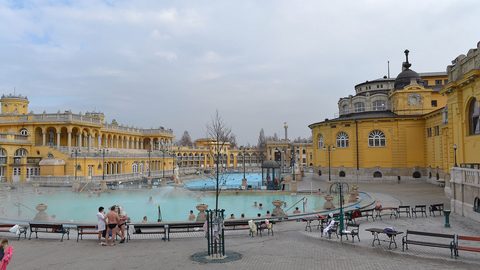 Budapest Thermal Baths Compared Which One and How It Works
Széchenyi, Gellért, Rudas, Király, or Lukács—which Budapest thermal bath fits your trip based on architecture, crowds, gender rules, and local authenticity.
Budapest Thermal Baths Compared Which One and How It Works
Széchenyi, Gellért, Rudas, Király, or Lukács—which Budapest thermal bath fits your trip based on architecture, crowds, gender rules, and local authenticity.