Poland: Kraków's Old Town, Gdańsk's Baltic Coast, and the Long Haul Across the Middle
Poland spans Kraków's medieval core, Wrocław's Silesian bridges, and Gdańsk's Baltic amber lanes, with real distances that reward a slower itinerary.
- Flag
-
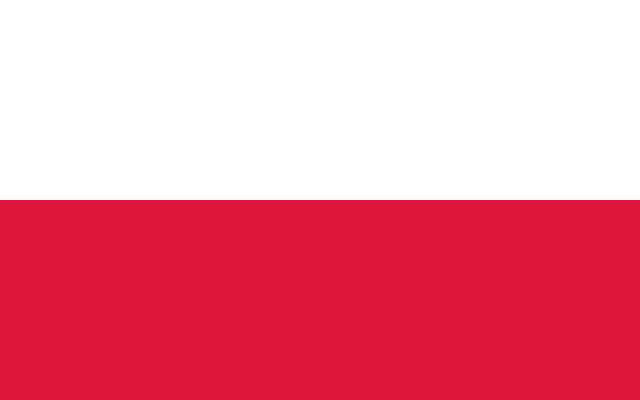
- ISO code
- PL
- Population
- 37,978,548
- Currency
- PLN
- Dial code
- +48
Poland: Kraków’s Old Town, Gdańsk’s Baltic Coast, and the Long Haul Across the Middle
Why This Route Demands Time
First time visitors assume Poland is a single day trip between cities. Kraków to Gdańsk by Pendolino express takes five hours and ten minutes at best. That is a real distance, a proper journey across the Polish plain, and treating it as a quick transfer is the fastest route to a frustrated trip. The country is larger than Italy. The geography between the Tatra Mountains and the Baltic Sea is flat, agricultural, and dotted with cities most itineraries ignore. Wrocław, Poznań, Toruń. They are not filler. They are the reason the journey works.
The circuit runs Kraków to Wrocław to Poznań to Gdańsk, or the reverse. That is roughly 650 kilometres of rail with four stops. At three days per city you need twelve days minimum. If you have seven, drop one stop. Wrocław and Gdańsk are non negotiable. Poznań or Toruń become the variable depending on whether you want Renaissance town halls or gingerbread and Gothic brick. Warsaw sits east of this line and demands its own trip. Do not try to tack it onto this route unless you have two extra days and a willingness to spend four hours on a train through flat countryside.
Kraków: The Southern Anchor
Kraków anchors the south. Wawel Castle, the cloth hall, the market square that covers four hectares, and the Jewish quarter of Kazimierz sit within a fifteen minute walk of each other. That compactness is the advantage. Cover the historic core in two days and still have time for Auschwitz Birkenau as a day trip. Book your Auschwitz slot in advance on visit.auschwitz.org. Entry is free but the timed entry between 10:00 and 16:00 in the main season must be reserved. The museum recommends minimum age 14. Bags larger than 30 by 20 by 10 centimetres go into paid lockers. The regional train from Kraków Główny to Oświęcim takes 1 hour 40 minutes to 2 hours 10 minutes. The bus from the MDA station is slightly faster at 1 hour 30 minutes to 1 hour 50 minutes. Either option leaves you with a 3.5 hour guided tour of both camps.
Wrocław: Islands, Bridges and Dwarfs
Wrocław sits west of Kraków. The express train from Kraków Główny to Wrocław Główny takes roughly 2 hours 45 minutes. Wrocław's character is distinct. The city sits on twelve islands connected by over one hundred bridges. The market square at 213 by 178 metres is one of the largest in Central Europe. The Gothic and Baroque architecture carries a visible German Breslau layer that Kraków lacks. Spend a day walking the Oder river islands and the cathedral island of Ostrów Tumski. The dwarfs. Over six hundred small bronze statues scattered across the city. They are not a tourist gimmick. They are a political joke from the 1980s Solidarity protests that became a permanent civic feature.
Poznań to Gdańsk: The Northern Leg
From Wrocław you go north. The express train to Poznań runs 1 hour 35 minutes to 1 hour 50 minutes. Poznań is the trade fair city with a Renaissance town hall rebuilt by Giovanni Battista di Quadro in the 1550s. The mechanical goats that butt heads at noon on the town hall clock tower are absurd and essential. Poznań's Ostrów Tumski cathedral island predates the city. The Prussian era fortifications ring the centre. Eat at Bar Mleczny Apetyt on ulica Szkolna 4, a milk bar serving two course meals with kompot for 18 to 30 złoty. Cash only. Monday to Friday 08:00 to 18:00, Saturday 09:00 to 16:00, closed Sunday.
Poznań to Gdańsk runs 2 hours 50 minutes to 3 hours 10 minutes by express train. Gdańsk Główny station drops you at the edge of the Hanseatic Old Town. Walk the Long Market, see the Gothic brick of St Mary's Church, the Crane on the Motława riverfront, the amber shops. Gdańsk's character is maritime and Hanseatic, distinct from the inland cities. The Baltic light changes the mood. The shipyard where the Gdańsk Agreement was signed on 31 August 1980, the birthplace of Solidarność, is a fifteen minute walk from the Old Town. The European Solidarity Centre museum there is worth the time.
Toruń: The Stop You Should Not Skip
Toruń sits between Poznań and Gdańsk by an hour on a regional train. The Gothic Old Town is a UNESCO site, the birthplace of Nicolaus Copernicus, and the source of the gingerbread that fills every shop on the main square. Toruń is the stop people skip because they are rushing to the coast. That is a mistake. The Teutonic castle ruins, the Leaning Tower, the planetarium, the entire fortified town wall that still stands. Toruń gives you a medieval city that was not bombed in 1945, which makes it different from every other stop on this route except Kraków.
Trains, Tickets and Practicalities
The Pendolino trains on the Kraków to Warsaw to Gdańsk corridor run at high speed. Outside those main lines the regional trains crawl at 45 to 65 kilometres per hour on non modernised routes. Rail operator PKP Intercity handles long distance. Polregio handles regional. Buy tickets in advance on the PKP Intercity website for the best fares. The Kraków to Warsaw Pendolino in second class advance purchase ranges from 49 to 169 złoty. At the station the same seat costs the maximum. Book at least two weeks ahead.
Card acceptance is near universal in the cities. Visa and Mastercard. American Express is less common outside international hotels. Contactless payment is standard. ATMs are everywhere but the Euronet machines offer poor conversion. Use bank affiliated ATMs instead.
Milk bars are the budget anchor of Polish travel. Bar Mleczny Pod Temidą in Kraków on ulica Grodzka 43. Bar Mleczny Syrena in Gdańsk on ulica Długa 61. Bar Mleczny Miś in Wrocław on ulica Kuźnicza 48. The 2026 rate for a two course meal with kompot runs 18 to 30 złoty. Cash only in many locations, some now accept card. Verify before you order. Operating hours are Monday to Friday 08:00 to 18:00, Saturday 09:00 to 16:00, closed Sunday.

The Middle Ground Most Itineraries Skip
Poznań and Toruń fill the space between Wrocław and the Baltic that most itineraries treat as dead air. They are not dead air. Poznań offers the Renaissance town hall with the mechanical goats at noon, the Prussian fortifications that you can walk through, and the cathedral island that predates the Polish state by centuries. Toruń offers a fully intact Gothic Old Town that survived the war, the birthplace of Copernicus, and a Teutonic castle ruin that tells the northern story of Poland's medieval history. These cities are each one day stops. Arrive in the afternoon, walk the centre, eat at the milk bar, sleep, see the main sight in the morning, and leave at midday. They break the train ride into manageable segments and they give you something to see that is not another market square.
The rail connections work in your favour if you plan them. Wrocław to Poznań is 1 hour 35 minutes. Poznań to Toruń is 1 hour 10 minutes. Toruń to Gdańsk is 1 hour 45 minutes. None of these are the five hour grind that Kraków to Gdańsk direct would be. The journey becomes part of the experience because you are moving through the Polish plain, past the agricultural flatlands, the small towns, the brick water towers, the long straight roads. This is not the Alps. It is the great northern European plain and it has its own austere beauty.
The Baltic Coast and the Teutonic Castle Trail
The Tricity and Beyond
Gdańsk is the northern anchor but it is not the only stop on the coast. The Tricity area includes Sopot and Gdynia, connected by local train from Gdańsk Główny in twenty to thirty minutes. Sopot has the longest wooden pier in Europe and a beach that fills in July and August. Gdynia has a modern port city feel and the ORP Błyskawica destroyer museum. The Teutonic castle trail runs south from Gdańsk to Malbork, twenty minutes by regional train from Gdańsk Główny. Malbork Castle is the largest brick castle in the world, a UNESCO site, and a full day visit. The train to Malbork runs frequently and the castle ticket with audio guide costs roughly 70 złoty. Book the audio guide. The printed materials are less informative.
The Gdańsk milk bar is Bar Mleczny Syrena on ulica Długa 61. The 2026 rate for a two course meal with kompot is 18 to 30 złoty. Cash only. Check the hours before heading there. The main Old Town restaurants charge three to four times that for comparable food. Use the milk bar for lunch and save the restaurant budget for dinner.
Kraków South and the Tatra Access
Mountain Days and City Days
Kraków is not just the Old Town. The city sits at the foot of the Tatra Mountains, a two hour bus ride south to Zakopane. Zakopane is the Polish mountain resort, crowded in summer and winter, but the hiking in the Tatra National Park is genuinely excellent. The Morskie Oko lake trail is the most popular. The route from Kraków to Zakopane by bus takes 2 hours to 2 hours 30 minutes from the MDA station. The regional train from Kraków Główny to Zakopane takes 2 hours 30 minutes to 3 hours. Do not try to do Zakopane as a day trip from Kraków. You need a full day for the hike alone and the bus ride back at 18:00 will be packed. Stay overnight in Zakopane or skip it entirely and focus on the city.
Kraków itself requires two full days. Day one covers Wawel Castle and the Old Town. Day two covers Kazimierz and the Jewish quarter. The Auschwitz day trip takes a full third day. The Wieliczka salt mine is another half day option but it is less essential than Auschwitz. Book the salt mine tickets in advance on the official website. The guided tour is the only way to visit and it sells out in peak season.


| Route | Train Type | Duration | 2026 Advance Fare Range (2nd Class) |
|---|---|---|---|
| Kraków - Wrocław | EIP | 2 h 45 min | 49 - 139 PLN |
| Wrocław - Poznań | EIC | 1 h 35 min - 1 h 50 min | 39 - 99 PLN |
| Poznań - Toruń | Regio | 1 h 10 min | 25 - 45 PLN |
| Toruń - Gdańsk | EIC | 1 h 45 min | 39 - 89 PLN |
| Kraków - Gdańsk (direct) | EIP/EIC | 5 h 10 min - 5 h 40 min | 89 - 199 PLN |
Common Questions
How many days do I need for this route?
Twelve days minimum for all five cities at three days each. Seven days if you drop one city, ideally Poznań or Toruń depending on your interest in Renaissance architecture versus Gothic brick. Five days is too few unless you fly into Kraków and out of Gdańsk and only visit those two with a day trip to Auschwitz.
Is the Pendolino worth the higher fare?
Yes on the Kraków to Warsaw and Warsaw to Gdańsk corridors where the speed advantage is real. No on the Wrocław to Poznań route where the EIC train is only slightly slower and costs significantly less. Book the EIP only for the long legs.
Should I rent a car instead of taking the train?
No. The train network connects all city centres directly. Driving adds parking costs in every city centre, traffic in Kraków and Gdańsk, and the risk of speed cameras on the A1 and A4 motorways. The train is faster, cheaper, and more reliable for this specific route.
What is the best time of year for this trip?
May and September. June through August brings crowds to Kraków and Gdańsk, especially July and August for the Baltic coast. December is a secondary peak for Christmas markets. April and October are shoulder months with moderate weather and fewer tourists.
Do I need cash or is card enough?
Card is enough for hotels, restaurants, and transport. Cash is required at milk bars, some market stalls, and smaller ruin bars in Kraków. Carry 200 to 400 złoty in small denominations. Withdraw from a bank ATM, not a Euronet machine.
Read next
-
 A Week in Marseille Beyond the Vieux-Port — Neighborhoods Worth Knowing
Most visitors never leave the harbor. This guide covers four Marseille neighborhoods worth a week of your time, with real prices from spring 2024.
A Week in Marseille Beyond the Vieux-Port — Neighborhoods Worth Knowing
Most visitors never leave the harbor. This guide covers four Marseille neighborhoods worth a week of your time, with real prices from spring 2024.
-
 Albania by Furgon and Coastal Ferry for Independent Travelers
A practical overland guide to Albania by local furgon and Adriatic ferry — real logistics on stations, small-town accommodation, and staying connected.
Albania by Furgon and Coastal Ferry for Independent Travelers
A practical overland guide to Albania by local furgon and Adriatic ferry — real logistics on stations, small-town accommodation, and staying connected.