Albania by Furgon and Coastal Ferry for Independent Travelers
A practical overland guide to Albania by local furgon and Adriatic ferry — real logistics on stations, small-town accommodation, and staying connected.
The minibus fills up without warning. One minute you are standing beside a dust-covered Transit van in a Tirana side street, and the next, a driver gestures at a seat, collects cash through the window, and pulls into traffic before you have properly sat down. Albania rewards travelers who can hold plans loosely and move at the pace of the road. That quality is either the trip's best feature or its biggest obstacle, depending on who you are.
Route Essentials
- Furgons leave when full, not on a fixed schedule. Arrive early and wait at the right departure cluster.
- Tirana's northern routes depart near Zogu i Zi roundabout. Southern routes leave from the Kombinat area.
- The Saranda to Corfu ferry takes under 35 minutes. Durres to Bari overnight is the classic Adriatic crossing.
- Albania sits outside EU free roaming coverage. A local SIM or eSIM is essential, not optional.
- Small-town guesthouses in Berat, Permet, and Gjirokaster rarely appear on booking platforms. Ask locally on arrival.
What the Furgon System Is and How It Actually Works
Albania's intercity movement runs almost entirely on shared minibuses. These are usually Mercedes Sprinters or Ford Transits, privately operated, covering routes from a 40-minute hop between neighboring towns to a four-hour haul into the southern highlands. The word furgon comes from German and simply means van. [Furgon transport](https://en.wikipedia.org/wiki/Furgon) took hold in Albania after 1991, when the communist-era state bus network collapsed almost overnight and private operators filled the gap within weeks. The structure those early operators established has remained essentially unchanged for over thirty years.
There are no tickets. There is no booking system. You find the departure point, identify the correct van, confirm the destination with the driver, and pay in cash when the vehicle moves. Fares are low by any European standard: between 150 and 600 lek for intercity routes, which works out to roughly 1.50 to 6 euros. The departure rule is simple and inviolable. The van leaves when every seat is full. On busy routes like Tirana to Shkodra, that wait might be fifteen minutes. On quieter southern routes, it can stretch past an hour.
Seat comfort is functional rather than generous. Legroom suits someone around 170 centimeters and becomes a negotiation for anyone taller. Drivers play music at a volume that discourages conversation. Stops happen when the driver decides they should, which typically means a roadside coffee at a petrol station where everyone climbs out, stretches, and returns without ceremony. It is the furthest thing from a managed tourist experience, and that is exactly the point.
Getting Out of Tirana: Finding the Right Departure Point
Tirana has no single central furgon terminal handling all destinations. The city's departure points are scattered across different neighborhoods, each serving a geographic cluster. This confuses first-time visitors, but the logic is actually geographic. Each cluster serves routes in its rough compass direction.
For northern destinations including Shkodra, Lezhe, and mountain villages toward Theth, the gathering point sits near Zogu i Zi, the large roundabout north of the Lana River. You will find groups of vans idling under or near the flyover, drivers calling out destination names, passengers checking available seats before committing. Shkodra-bound vans fill fastest and leave most frequently, roughly every hour during the morning peak.
For southern routes toward Berat, Fier, Gjirokaster, and the coast at Saranda, departures cluster near the Kombinat neighborhood, southwest of the city park. A taxi from the center costs a few hundred lek. The walk from the main pedestrian boulevard takes around twenty minutes. In both cases, simply naming your destination out loud gets you pointed to the right vehicle within seconds. Keep small bills. Change is often unavailable.
The Shkodra Run: Two Hours North to the Lake
Shkodra is the natural first stop on any northern route. The 110-kilometer road from Tirana has improved substantially since 2015, and the journey runs close to two hours on a good day. The landscape shifts from Tirana's peri-urban sprawl through agricultural flatland, river floodplains, and low hills that eventually frame Lake Shkodra on the city's western edge. The lake is one of the largest in the Balkans, shared between Albania and Montenegro, and the late-afternoon light across the water from the Rozafa Castle is one of those views that genuinely earns the trip.
Shkodra's own furgon hub sits at the southern end of the city. From there you can pick up onward transport north toward the Montenegro border crossing at Han i Hotit, northeast into the mountains toward Theth, or back south to Tirana. Mountain village services drop sharply in frequency between November and March, so confirm local conditions before heading into the highlands in winter.
The city rewards an afternoon at minimum. The old bazaar still functions as an actual market rather than a tourist-facing one. A cycling culture more pronounced than anywhere else in Albania gives the streets a calmer rhythm. Guesthouses along Rruga Kolë Idromeno and near the riverside ran between 25 and 45 euros for a double with breakfast as of late 2024. Arriving without a reservation is normal outside the July and August peak and usually works fine.
Moving South Through Berat and Gjirokaster
The southern half of the overland route passes through two of Albania's most architecturally striking cities. Berat sits about two and a half hours from Tirana by furgon. The road cuts through hills above the Seman river valley and delivers you into a city whose Ottoman-era residential quarter climbs directly above a Byzantine lower town. The description of Berat as the city of a thousand windows is a cliche that the view from the castle makes completely understandable. Entry to the castle complex is free or nominal depending on the season.
From Berat, the route south to Gjirokaster runs through Fier, Tepelene, and the Drino valley. Gjirokaster is a further two to three hours, depending on stops. The city's old stone quarter is a UNESCO World Heritage site and one of the best-preserved Ottoman town centers in the Balkans. Novelist Ismail Kadare grew up here, and his fiction treats the city as a labyrinthine character in itself, which makes reading his work before arrival genuinely worthwhile. The fortress above town contains a decommissioned US Air Force jet that made an emergency landing in 1957 and has sat in the courtyard ever since with matter-of-fact permanence.
In both cities, guesthouses in the old quarters are the better choice over hotels near the main roads. Prices are lower, rooms are often inside historic stone buildings, and owners tend to be useful sources of information about onward transport and regional conditions.
The Coastal Ferry Crossing: Saranda to the Adriatic
Albania's ferry options fall into two distinct categories that serve very different itinerary shapes. The short island hop and the overnight Adriatic crossing are not interchangeable.
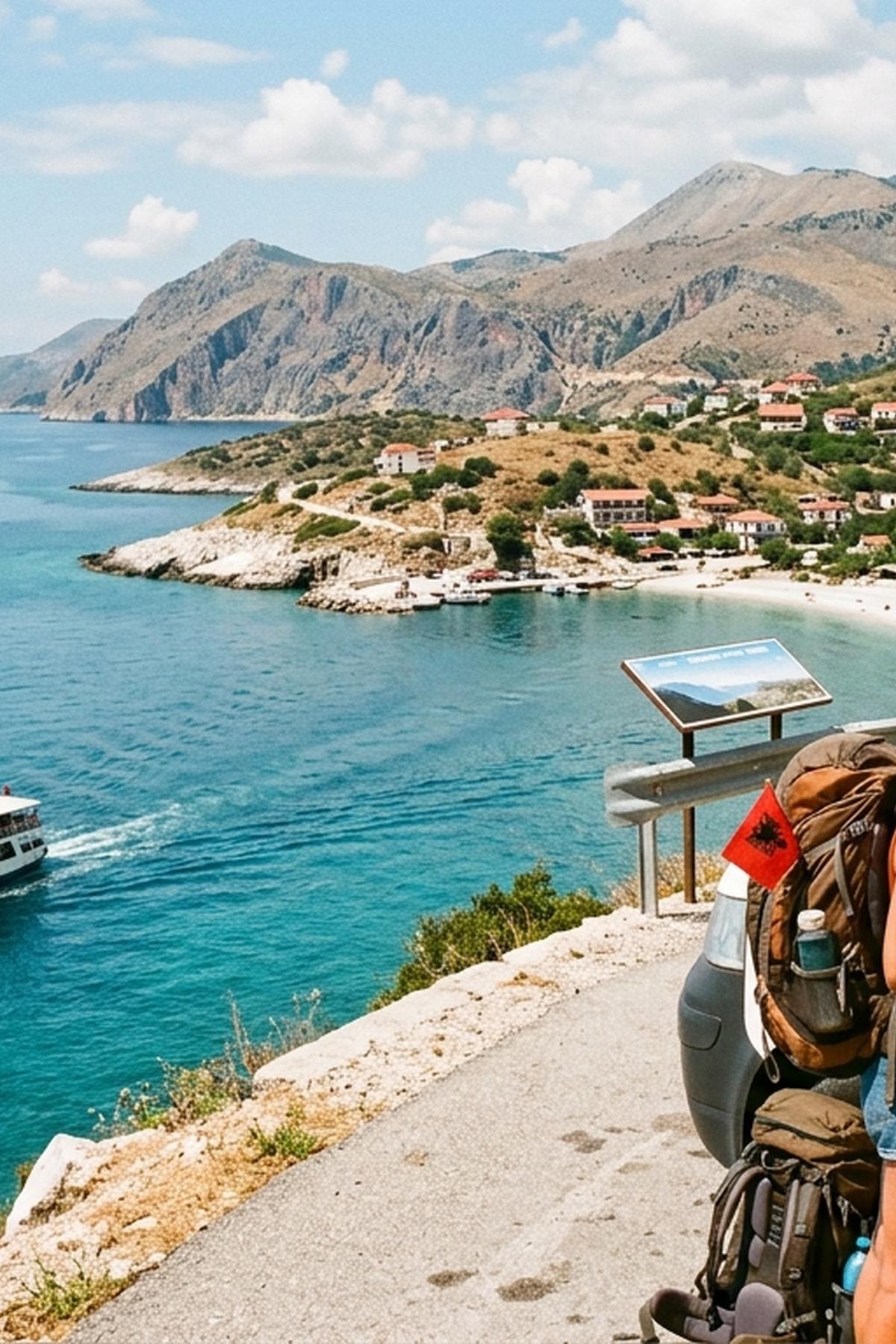
Saranda, at Albania's southern tip, runs ferries to Corfu in Greece throughout the tourist season and at reduced frequency in winter. The crossing takes between 25 and 35 minutes depending on the vessel and sea conditions. Tickets run around 19 to 25 euros one way. Multiple operators compete on the route, and the port is small enough that comparing prices on the day of travel is practical. This crossing suits travelers combining Albania with the Greek islands, since Corfu connects onward by ferry to Paxos, Lefkada, and the mainland port of Igoumenitsa.
The longer Adriatic crossing, from Durres or Vlora to Bari or Brindisi in Italy, suits travelers entering or exiting Albania as part of a wider Balkan overland loop. The Durres to Bari route takes around nine hours and runs several times a week. A basic passenger ticket without a cabin runs between 40 and 65 euros in shoulder season, rising in August. Booking a cabin is worth considering for comfort on an overnight crossing, but a reclining seat in the main lounge is functional and considerably cheaper.
Before boarding any Albanian ferry, working through the following sequence prevents the kind of delays that make departures feel chaotic:
- Confirm which quay your ferry uses. Durres port has multiple terminals and the passenger entrance is often a different gate from the vehicle entrance.
- Arrive at least 90 minutes before the scheduled sailing. Passport control moves slowly during peak departures and there is no fast lane.
- Bring cash in lek for port taxes sometimes collected separately at the terminal. Card readers exist at some counters but are unreliable enough that cash is safer.
- Check passport validity before leaving home. Both Italian and Albanian border officials enforce the six-month remaining validity rule and will turn you back at the gate if you are short.
- Download your ferry booking confirmation to your phone rather than relying on a printed copy. Digital documents are accepted and have saved real time when printers at guesthouses stop cooperating.
Staying Connected When Timetables Only Exist in Someone's Head
A smartphone with working data is not a convenience on this route. It is the difference between arriving somewhere and being stranded. Furgon departure points are not marked on most maps. Rural bus stops are a bend in the road where the driver knows to slow down. Guesthouses that list only a phone number require a call or a WhatsApp message to confirm a room. Mountain road conditions after rain need checking before you commit. You need data that works reliably.
The complication for most European travelers is that Albania is not a member of the European Union. EU free roaming regulations, which allow travelers to use their home SIM across member states at domestic rates, do not apply here. A Dutch, German, or British SIM reverts to international roaming rates the moment you cross into Albania from Montenegro or North Macedonia, and those rates can reach several euros per megabyte on some plans.
Two solutions exist. A local Albanian SIM from Eagle Mobile or ALBtelecom costs two to five euros at a phone shop near any airport arrivals exit or at the mobile shops along Tirana's main avenues. It gives you a generous data allowance for domestic use. The eSIM route means you have data working before your plane lands, which matters if you are arriving late at night or need to find transport from the airport immediately. A solid travel connectivity guide walks through the practical comparison between local SIM options and eSIM providers for this part of Europe, and it is worth reading before you finalize your departure plans.
For offline backup, download the HERE Maps data pack for Albania before leaving a city with stable WiFi. Google Maps offline covers urban areas reliably but patches out in the interior. A translation app with Albanian loaded offline takes less than 100 megabytes and covers situations in southern villages where English is not spoken. Younger Albanians in cities often speak excellent English, but the highland interior runs entirely on Albanian, and sometimes Italian picked up from decades of Italian television reception.
Finding a Bed in Towns That Do Not Appear on Booking Platforms
Accommodation in Albania has split into two distinct tiers in recent years. In Tirana, Saranda, and increasingly Berat, you have proper hotels, boutique guesthouses on major booking platforms, and even international hostel brands. Outside those centers, the picture thins out and becomes considerably more interesting.
Permet, in the Vjosa river valley, has quietly become a draw for travelers interested in hiking, rafting, and genuine slow travel. The guesthouses there are run by families who started hosting travelers relatively recently, often since around 2018 when the Vjosa began attracting attention for its clear water and undisturbed valley. Rooms are clean, dinners are enormous, and a night with dinner rarely exceeds 25 euros. None of these places maintain consistent online listings. You either arrive with a name passed along from someone who went before you, or you show up and ask around.
Leskovik, a small town near the Greek border, has one guesthouse above a cafe that appears and disappears from the internet depending on whether anyone has updated it recently. Voskopoja, one of the oldest continuously inhabited towns in the Balkans with a cluster of Baroque churches and a faded cosmopolitan past, has two modest hotels that operate in summer and largely close outside it. In both places, the method is identical. Find a cafe. Order a coffee. Ask about a room. Someone knows someone.
This system demands flexibility and rewards patience. It also means you sometimes end up at a family dinner table, hearing accounts of local history from people who have lived it. No booking platform has worked out how to replicate that.
What This Route Leaves You With
Albania by furgon and ferry runs at a pace that forces attention. You cannot skim it from a tour bus window or compress it into a weekend. The route from Tirana north to Shkodra, south through Berat and Gjirokaster, out to the coast at Saranda, and across the water to either Greece or Italy is probably ten days of actual travel if you stop properly. Twelve is better.
What accumulates over those days is a sense of a country still in the middle of its own story. Road infrastructure is uneven: some stretches are new and smooth, others are mountain tracks that require checking conditions before you commit. The cities carry their Ottoman and communist architectural layers visibly and without apology. The food in a family kitchen, byrek straight from the oven and tavë kosi in its clay dish, tastes like it was made for the people eating it rather than for a menu description.
The furgon is slow, loud, and occasionally baffling. It also puts you next to people going home to their families rather than to the same guesthouse as every other visitor. The ferry across the Adriatic, or the short hop to Corfu, closes a loop that most travelers on Albanian itineraries never draw. The ones who do tend to remember it in that specific way that belongs to trips where the logistics were part of the experience and not simply an obstacle to it.